

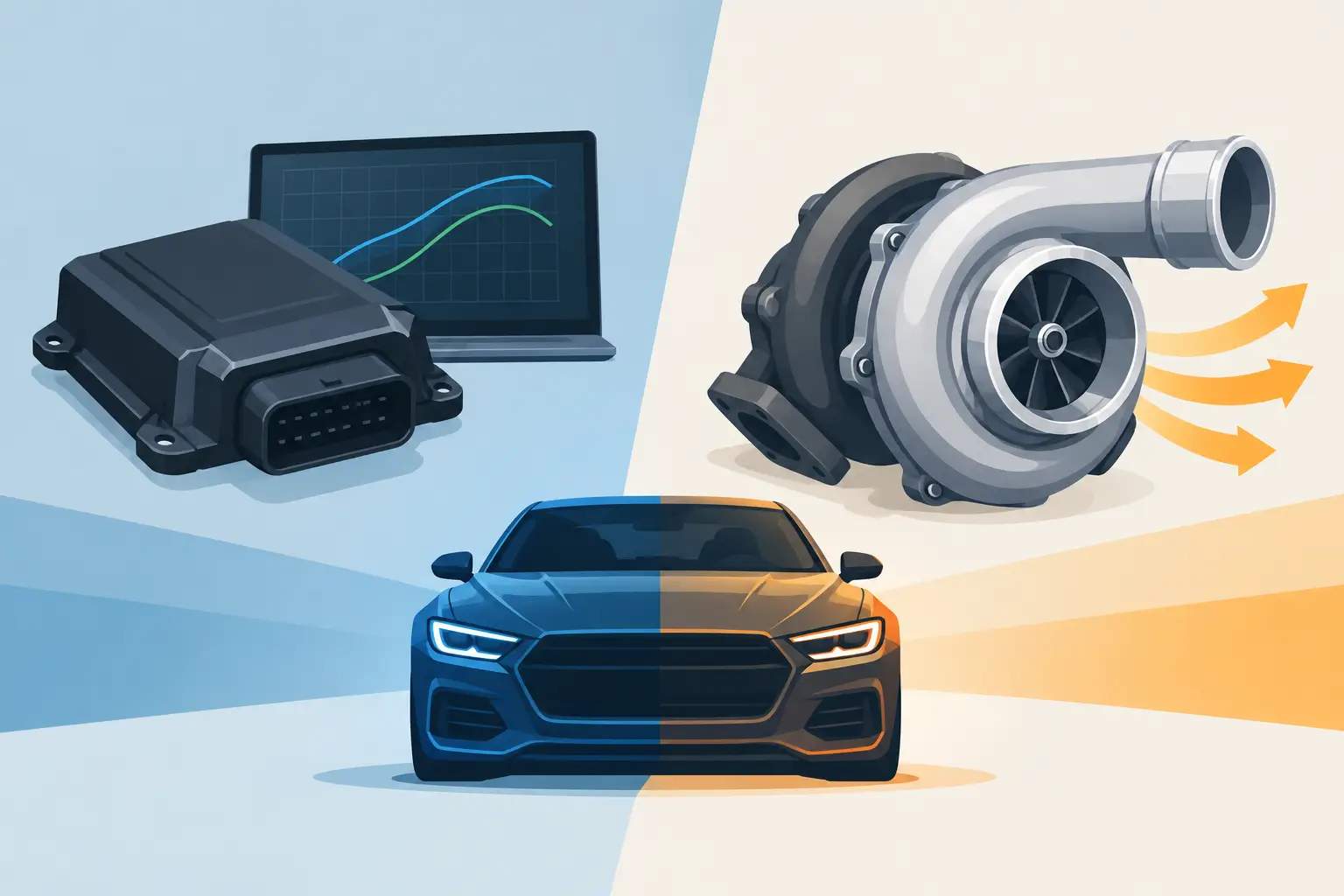
Tuning Box Versus Turbo Upgrade: Which Fits?
A diesel ute can feel held back long before it runs out of mechanical capability. Maybe it hesitates when pulling into traffic, drops a gear too readily on a hill, or feels flat with a caravan behind it. The tuning box versus turbo upgrade decision comes down to what you want to change: the way your existing engine delivers its performance, or the hardware capacity of its forced-induction system.
Both paths can have a place. They are not interchangeable, though, and treating them as if they are can lead to an expensive result that does not suit how you actually use the vehicle. For most owners chasing stronger everyday response, easier towing and potential fuel-efficiency gains, a properly programmed plug-in tuning module is the more direct starting point.
Tuning Box Versus Turbo Upgrade: The Core Difference
A vehicle-specific tuning box works with signals from the engine’s management system to refine fuel delivery and, depending on the application, related operating parameters. Its purpose is to make better use of the engine and turbocharger already fitted to the vehicle. The result should be smoother, more accessible torque and improved throttle response through the part of the rev range used most often on the road.
A turbo upgrade replaces the factory turbocharger with a different unit, often one designed to move more air or deliver boost differently. This is a physical modification, not simply an electronic adjustment. It can suit vehicles being built for high-output applications, competition use, major towing demands or a broader package of mechanical changes.
That distinction matters. A tuning box is primarily about optimising usable performance from a standard mechanical package. A turbo upgrade is about changing a key part of that package. One is a plug-in, reversible enhancement; the other is a workshop job that requires careful component selection and supporting work.
What You Feel From Behind the Wheel
For daily driving, the most valuable performance improvement is rarely a peak number quoted at high revs. It is the response you feel leaving a roundabout, joining the motorway, overtaking safely or climbing a long grade with weight in the tray.
A quality tuning box is designed to improve that usable middle range. In a diesel 4WD or ute, that generally means stronger torque delivery at normal engine speeds, with less need to work the accelerator or wait for the transmission to react. When correctly matched to the exact vehicle, fuel type, transmission and variant, the change should feel progressive rather than abrupt.
A turbo upgrade can alter the character of the engine more dramatically, but the outcome depends heavily on turbo sizing and the rest of the setup. A larger turbo may support more airflow at higher engine speeds, yet it can be a poor fit for an owner who mainly wants crisp low-to-mid-range response around town or while towing. Turbo selection is a balancing act between response, airflow capacity and the intended use of the vehicle.
This is why the biggest turbo is not automatically the best turbo. For an everyday Australian ute that spends weekdays commuting and weekends towing a boat or camper, predictable response is usually worth more than chasing an ambitious headline figure.
Installation, Downtime and Practicality
The installation difference is substantial. A vehicle-specific tuning module uses plug-and-play connections designed for the relevant engine layout. Many owners can fit one themselves with basic mechanical confidence, following the supplied instructions. There is no need to remove major hardware, fabricate pipework or leave the vehicle off the road for an extended workshop booking.
That convenience also gives you flexibility. If you sell the vehicle, change it, or simply want to return it to standard configuration, a plug-in module can be removed. The key is choosing a product programmed for your exact vehicle rather than a generic box with a broad claim of compatibility.
A turbo upgrade involves access to the exhaust and intake sides of the engine, oil and coolant connections where applicable, and careful reassembly. Depending on the vehicle and turbo choice, it may also call for associated changes to intake plumbing, exhaust components, intercooler capacity or other supporting systems. Labour, parts availability and workshop time all add to the real cost.
For a work vehicle, family 4WD or only car, that downtime matters. It is worth factoring in before comparing only the advertised price of a turbocharger against the price of a tuning box.
Cost Is More Than the Part Price
A tuning box has a relatively clear purchase path. Select the vehicle accurately, receive the module configured for that application, install it and assess the improvement in normal driving. Costs are more predictable because the product is engineered as a specific plug-in solution.
A turbo upgrade can start with the cost of the turbo itself but rarely ends there. Professional fitting, gaskets, fluids, related parts and any supporting modifications must be allowed for. If the vehicle has high kilometres, it is also sensible to assess the condition of surrounding components before investing in a larger performance project.
Neither approach should be selected on price alone. A cheap, rebadged tuning box with vague vehicle coverage is not equivalent to a German-designed and manufactured module individually programmed for a specific engine and transmission. Likewise, a bargain turbo that is poorly matched to the application can create a result that is disappointing to drive.
The better question is: what result are you paying for? If you want stronger everyday pulling power with straightforward fitment, an engineered tuning box often delivers the more efficient path. If you are deliberately building a more extensive mechanical package, a turbo upgrade may be part of that plan.
Fuel Economy: Where Expectations Need to Be Realistic
Fuel economy is one reason many diesel owners consider a tuning box. Additional usable torque can allow the vehicle to maintain speed with less throttle input in suitable conditions. This can be particularly noticeable on open-road runs, when towing within the vehicle’s limits, or in a loaded 4WD that no longer needs to work as hard to hold momentum.
But economy is never automatic. Use the extra response to accelerate harder at every opportunity and fuel use can rise. Add larger tyres, roof racks, heavy accessories or a loaded trailer and those factors remain part of the equation. A tuning box can improve efficiency potential, but the final figure still reflects driving style, load, terrain and maintenance.
A turbo upgrade should not be chosen primarily as a fuel-saving measure. Its main role is to change airflow capability and performance potential. Any economy outcome will depend on the entire setup and how it is driven.
Why a Tuning Box Is the Better Fit
A tuning box is the practical choice for owners who are happy with their factory turbocharger but want the vehicle to feel more capable. It suits the Ranger, Hilux, D-Max, Triton, LandCruiser or passenger diesel owner who wants more confident overtaking, easier towing and a more relaxed drive without turning the vehicle into a lengthy modification project.
It also suits buyers who value precision. Modern vehicles have many variants, and small specification differences can matter. Engine code, production year, fuel system and transmission all affect the correct product selection. A proper vehicle finder is part of ensuring the module is right for the vehicle.
Chip My Diesel focuses on this vehicle-specific approach, rather than selling a one-size-fits-all box dressed up with a different label. That distinction is worth checking in a crowded market where similar-looking modules can vary significantly in engineering, calibration and support.
If you’re still on the fence about if a tuning box is right for you, give us a shout here, and we can tell you what you can expect from your vehicle.
Happy Driving!